Public finances: Economic indicators
The public finances include government borrowing and debt. Find the latest data on UK borrowing and debt as well as forecasts for the future.

The UK is committed to spending 0.7% of its gross national income on aid each year. While this gives a sense of the scale of overall future spending in this area, there are still questions to be answered about exactly how much money is spent, who spends it and where. Some of these questions may
The UK is committed to spending 0.7% of its gross national income on aid each year. While this gives a sense of the scale of overall future spending in this area, there are still questions to be answered about exactly how much money is spent, who spends it and where. Some of these questions may be answered in the Spending Review on 25 November.
The International Development (Official Development Assistance Target) Act 2015 made it a legal requirement for the UK to spend at least 0.7% of gross national income on aid. The UK was already meeting this target prior to the Act, having done so for the first time in 2013. The government aims to hit, but not significantly exceed, the 0.7% level.
In 2016, 0.7% of gross national income is forecast to be £13.4 billion (using OBR forecasts from July 2015 and gross national income estimates produced using current methods). Of course this figure is based on current forecasts, and forecasts change – we will have new forecasts published alongside the Spending Review, and we will not know what 0.7% of gross national income in 2016 actually has been until after that year ends.
In 2014, an estimated £11.8 billion was spent on aid.
The 0.7% spending commitment relates to spending both by the Department for International Development (DFID) and by other government departments and official sources.
In 2014, DFID accounted for 86% of aid spending – about £10.1 billion out of the total of £11.8 billion from official UK sources.
Budgets in 2015/16
The government is looking for savings to help reduce the budget deficit, and it has been suggested that the aid budget could be used more to support the work of departments other than DFID. Such changes have already started to happen, for example since the 2013 Spending Review, the amount allocated to DFID in 2015/16 has changed: its resource DEL – the part of the budget that covers most of DFID’s non-capital spending – has fallen by more than a billion pounds, from £8.5 billion to £7.4 billion.
This change is due to transfers to other government departments, largely to the new conflict, stability and security fund (CSSF) launched in April 2015, which replaces the DFID, FCO and MOD Conflict Pool. The new CSSF brings together the UK’s contribution to multilateral peacekeeping, security and defence activities, along with aid and non-aid programmes in countries at risk of instability. Much of the CSSF settlement was originally part of DFID’s budget but the majority has now been transferred to the budgets of other parts of government. In total, £823 million has been transferred from DFID in relation to the CSSF, mostly to the FCO (£739m).
Beyond this, around £270 million of aid spending for 2015/16 was moved from DFID to other departments, for them to spend in line with the standard international definition of aid. The FCO has received almost half of this budget, and a third has gone to the Department for Business, Innovation and Skills, which is responsible for certain spending on research and science.
The Spending Review and budgets from 2016/17
As part of the Spending Review, the Treasury has been running a competitive process across government to scrutinise aid spending across government and to ensure that aid spending represents “high value for money”.
It has been reported that the FCO has been pressing for more money through this route, including to spend on promoting trade and investment in various emerging markets. The Department for Business, Innovation and Skills is said to have requested funding for science that could help people in developing countries, including the development and distribution of vaccines.
DFID are currently reviewing their aid spending, through bilateral and multilateral aid reviews. The bilateral aid review will help DFID target and allocate its funding by looking at factors such as the level and persistence of extreme poverty in each country and the ability of the governments to finance their own development needs. The multilateral aid review will look at providing funding through different multilateral organisations, exploring factors such as the value for money provided by potential partners and whether their objectives are aligned with those of the UK.
The bilateral and multilateral aid reviews may not be completed by the time of the Spending Review – the multilateral aid review at least is due to be published in March 2016. We may however have more information in a Single Departmental Plan for DFID. Single Departmental Plans are a new set of publications, being developed alongside the Spending Review, which are expected to set out government priorities alongside the resources to be dedicated to them.
The Conservative manifesto also gives some indications as to future activity – talking about immunisation, the development of new drugs, education, nutrition, access to clean water and sanitation, gender equality, jobs and growth, and responding to humanitarian crises. It also proposed that payment by results be expanded and that aid money to governments be clearly earmarked for specific purposes.
Earlier this month, the Prime Minister announced that at least half of the Department for International Development’s budget will be spent on stabilising and supporting broken and fragile states. In 2013, 43% of UK aid was spent in fragile and conflict-affect states.
Update:
Shortly after the original publication of this article, the Government published UK aid: tackling global challenges in the national interest (23 November 2015). This new strategy document explains that the aid budget will be restructured. Underpinning the strategy is the principle that the UK’s development spending “will meet our moral obligation to the world’s poorest and also support our national interest”.
There will be four strategic objectives for aid spending:
Announcements include:
Sources and further information:
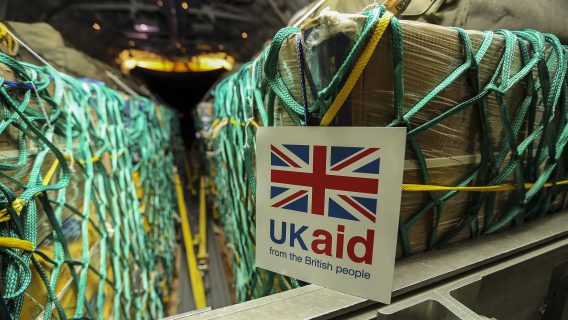
Picture Credit: UK aid being unloaded at RAF Brize Norton in Oxfordshire by DFID – UK Department for International Development, Creative Commons Attribution 2.0 Generic (CC by 2.0)
The public finances include government borrowing and debt. Find the latest data on UK borrowing and debt as well as forecasts for the future.
On 28 October 2026 the Chancellor will present plans for the economy, including taxation and spending, in the Budget. What happens during and after the Budget?

What is the value of UK aid to Pakistan, on what priorities does it focus, and how effective has it been?