Complaining to the Local Government and Social Care Ombudsman
How to take complaints about services provided by local authorities to the Local Government and Social Care Ombudsman.

The UK Government planned to require voters to show ID in polling stations to prevent ‘personation’.
This one-off briefing was published in October 2019. For up-to-date information on voter ID see the Commons Library briefing, Voter ID.
______________________________________________________________________________
In the 2019 Queen’s Speech the Government committed to require voters to show photographic ID at UK general elections.
This Insight looks at why this is being introduced and the reactions to it.
Voters in Great Britain don’t need to show any ID at a polling station. Staff ask the voter to confirm their name and address on the register and then hand them a ballot paper.
In Northern Ireland the rules are different. Voters there must already show photo ID before being given a ballot paper at all elections. They must bring either: a UK, Irish or EEA driving licence, a passport, an Electoral Identity Card, or a Translink pass (Northern Ireland’s main public transport provider).
The ID doesn’t need to be current, but the photo must be of a good enough likeness to confirm the voter’s identity.
Requiring voters to show ID aims to prevent people from pretending to be someone else at the polling station, an electoral offence known as ‘personation’.
In a 2014 report the Electoral Commission, an independent body set up by UK Parliament, recommended that a voter ID scheme, similar to the one in Northern Ireland, should be introduced in the rest of the UK.
It found “no evidence to suggest that there have been widespread, systematic attempts to undermine or interfere with recent elections through electoral fraud,” but said that not requiring ID was a weakness in the system. It was also concerned that polling stations might become more vulnerable to fraud as efforts have been implemented to make postal voting and voter registration more secure.
The Commission found that there was “little evidence to suggest that the identity-checking scheme applied in Northern Ireland presents difficulties for people in terms of accessibility.”
This was echoed by the Government’s Anti-Corruption Champion, Lord Pickles, in his report on electoral fraud in 2015. He recommended introducing voter ID, saying:
“There is no need to be over elaborate; measures should enhance public confidence and be proportional…The Government may wish to pilot different methods. But the present system is unsatisfactory; perfection must not get in the way of a practical solution.”
The Government took up Lord Pickles’s suggestion to pilot voter ID schemes. Five English local authorities took part during local elections in 2018 and ten in 2019. The Electoral Commission evaluated both years’ trials (the reports for 2018 and 2019 are available on its website).
The Commission said that the proportion who couldn’t show ID and who did not return to vote in 2019 ranged from 0.03% to 0.7%. It noted the schemes appeared to have a positive impact on people’s perception of the security of the polling station process, but important questions remained about how an ID requirement would work in practice, particularly at a national poll with higher levels of turnout.
It identified three key areas for Parliament to consider about any scheme:
The Government said that, “the overwhelming majority of people who came to polling stations were able to cast their vote,” but critics say there is no need for voter ID as the type of electoral fraud it prevents, personation, is almost non-existent.
Levels of recorded electoral fraud are low and only a small proportion relate to personation. This Library Insight looks at the level of electoral fraud in recent years.
Personation fraud was a problem in Northern Ireland elections before ID was introduced. In the 1983 UK General Election there were 149 arrests for personation, but since 2002 there has been just one conviction for personation.
Critics also say it may prevent certain groups from voting. This Library Insight looks at how many people have access to types of photo ID. The Equality and Human Rights Commission wrote to the Cabinet Office in advance of the 2018 pilots expressing concern that some voters would be disenfranchised by voter ID requirements.
In July 2018, Jo Miller, then returning officer and chief executive of Doncaster Council, and president of the Society of Local Authority Chief Executives (SOLACE) wrote an article for the Municipal Journal on the pilots. She said:
“Electoral Commission data shows that in 2017, of the 45 million votes cast, there were 28 allegations of impersonation – that is one for every 1.6 million votes cast.
“That rather begs the question: what problem are we trying to solve?”
She also pointed out that in a time of local authority resource restraints, voter ID would be an expensive addition to running elections.
Others have suggested that resources would be better used improving electoral registration. Electoral Commission estimates show between 8.3 and 9.4 million people in Great Britain who are eligible to be on the local government registers are not correctly registered.
The Government is expected to bring forward these proposals in an Electoral Administration Bill. The Bill is also expected to make some changes to postal and proxy voting to improve security. It will also make it easier for disabled voters to vote at polling stations.
These will apply to all elections in England and UK parliamentary elections in Scotland and Wales. In Scotland and Wales, it will be for the devolved administrations to decide whether to apply voter ID measures to local and devolved elections.
Voter ID: Key facts and figures, House of Commons Library.
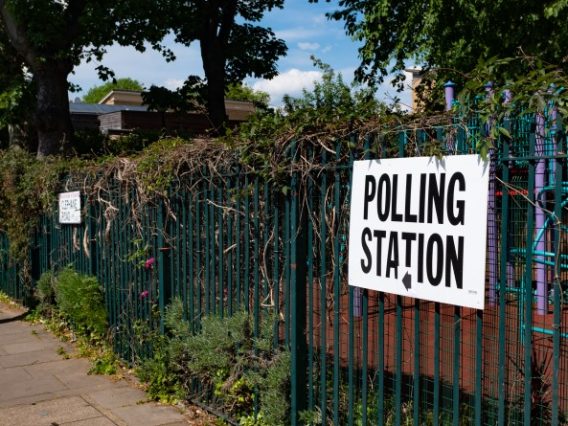
Photo: Elections 2010-71 by AdamKR; Creative Commons Attribution-ShareAlike 2.0 Generic (CC BY-SA 2.0)
About the author: Neil Johnston is an election specialist at the House of Commons Library.
How to take complaints about services provided by local authorities to the Local Government and Social Care Ombudsman.
A briefing paper which "maps" (or summarises) the main elements of the United Kingdom's uncodified constitution.

This list notes the number of by-elections by session since 1945-46 together with a list of the the successful candidates in by-elections since 2005.