Complaining to the Local Government and Social Care Ombudsman
How to take complaints about services provided by local authorities to the Local Government and Social Care Ombudsman.

In the 2019 local elections, the Electoral Reform Society has put the number of uncontested seats at 148, around 2% of the seats being contested.
Uncontested elections might sound
like a relic of the Victorian age. But they continue to occur regularly in local
authority elections, when there is only one candidate for a council seat. When this
occurs, councillors – who decide on social services, council tax, the repair of
roads and much else – are elected without any votes being cast.
With the local council elections taking place on Thursday (2 May), this Insight looks at this unusual aspect of democracy in the UK. It will explore the historical background, trends, prevalent ‘uncontested’ areas and wider debates over the local election electoral system.
Although it is hard to imagine
today, during the Victorian era more than half of parliamentary seats at
general elections could go uncontested. This pattern changed due to the introduction
of the secret ballot, the expansion of the vote, and the improved organisation
of political parties. Yet, even in 1931 – the second general election after
universal suffrage – more than 10% of seats were uncontested. As recently as 1951,
four MPs in Northern Ireland were elected unopposed. In the constituencies of
Antrim North, Antrim South, Armagh, and Londonderry there was only one
candidate, and so no voting took place. In Great Britain the last two
uncontested parliamentary elections were in the quirkily named Liverpool
Scotland and in Rhondda West constituencies during the 1945 General Election.
The chart below shows the change over time.

In more
recent times, by convention the main parties do not put up candidates in the
seats of a sitting Speaker, who stands as the Commons Speaker seeking
re-election. However, other parties and independent candidates do stand for
that seat.
Uncontested elections continue,
albeit on a smaller scale, in local council elections. These decide the composition
of local authorities – which oversees public services such as planning
decisions, social care, road repairs and waste collection.
The chart below shows the percentage of wards (the areas used in local elections) that have been uncontested in local elections in Great Britain since 1973.

The graph shows that since 1973 there has been a gradual reduction in the total number of uncontested wards. In 1979 there were no contests in 18.2% of all council wards. By contrast, in 2018 for the first time there were no uncontested wards. However, there is considerable year-on-year variation. This is because councils don’t all have elections at the same time, which impacts on the number of uncontested wards. In the 2019 local elections, the Electoral Reform Society has put the number of uncontested seats at 148, around 2% of the seats being contested.
Different types of councils, in various parts of the UK, have elections in different years. For example, Welsh council elections take place every four years. In 2017, 10.4% of Welsh council wards were uncontested. Indeed, in the ward of Yscir, in Powys County Council nobody stood at all. Likewise, district councils in rural areas which have had elections in 2011, 2015, and will do in 2019, also have a higher proportion of uncontested elections. It has also been suggested that parish councils only had around 20% of their parishes contested in 2015.
This contrasts with urban areas,
which rarely have any uncontested elections: in London borough elections all
wards have been contested since the 2002 elections. In other metropolitan councils
every ward has been contested since 2016.
The Electoral Reform Society has highlighted the number of uncontested elections as part of its call for a change in the electoral system used in local elections. Councils in England and Wales use the first-past-the-post electoral system. This means the candidate(s) with the most votes are elected. The Society argue that areas such as Scotland and Northern Ireland, which elect councillors through a system of proportional representation, the Single Transferable Vote, have fewer uncontested elections. In 2003, at the last Scottish local elections held under first-past-the-post, sixty-one wards (5% of the total) were uncontested. In 2017 there were three uncontested wards. In 2014 there were no uncontested wards in the Northern Ireland local elections.
In July 2017 the Welsh Government launched a consultation about electoral reform in Welsh local government. A stated aim was to reduce the number of uncontested seats.
Overall, the trend in uncontested
elections is falling. How long until they disappear entirely, joining rotten
boroughs among the curios of electoral history, remains to be seen.
About the author: Edward Hicks is a researcher in the House of Commons Library, specialising in local government.
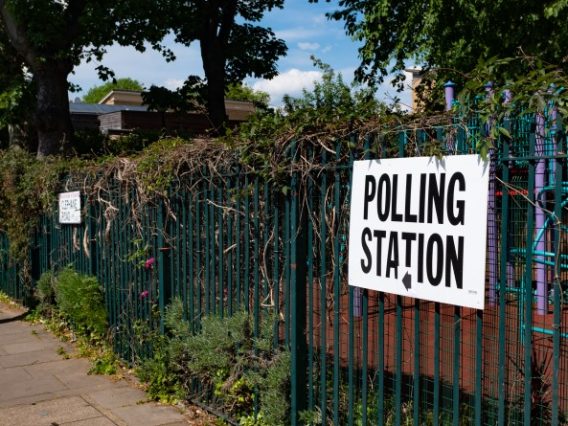
Image: Polling station (way in) by Paul Albertella. Licensed under (CC BY 2.0).
How to take complaints about services provided by local authorities to the Local Government and Social Care Ombudsman.
A briefing paper which "maps" (or summarises) the main elements of the United Kingdom's uncodified constitution.

This list notes the number of by-elections by session since 1945-46 together with a list of the the successful candidates in by-elections since 2005.